
Art Writing
The Eye Is Not Satisfied With Seeing
Jennifer Packer’s 2022 solo show at the Whitney Museum of American Art, The Eye Is Not Satisfied With Seeing can be considered as a sort of retrospective, displaying over thirty works– drawings and paintings– from the past decade. Packer is 37 years old, so that in and of itself speaks volumes of her shocking level of success and prowess. Packer often depicts loved ones as well as flowers in her renderings, exploring themes of intimacy, representation, and pleasure.
More than once, the titles in the show reference the Biblical, paralleling the sacred nature of her images. The exhibition title itself alludes to Ecclesiastes 1:8 – “All things are wearisome, more than one can say. The eye never has enough of seeing, nor the ear its fill of hearing.” The chapter speaks to the futility of life itself, for it has all been done before. In the context of Packer being a visual artist whose work is more interested in obscuring than depicting, the verse may reference the old idiom that ignorance is bliss.
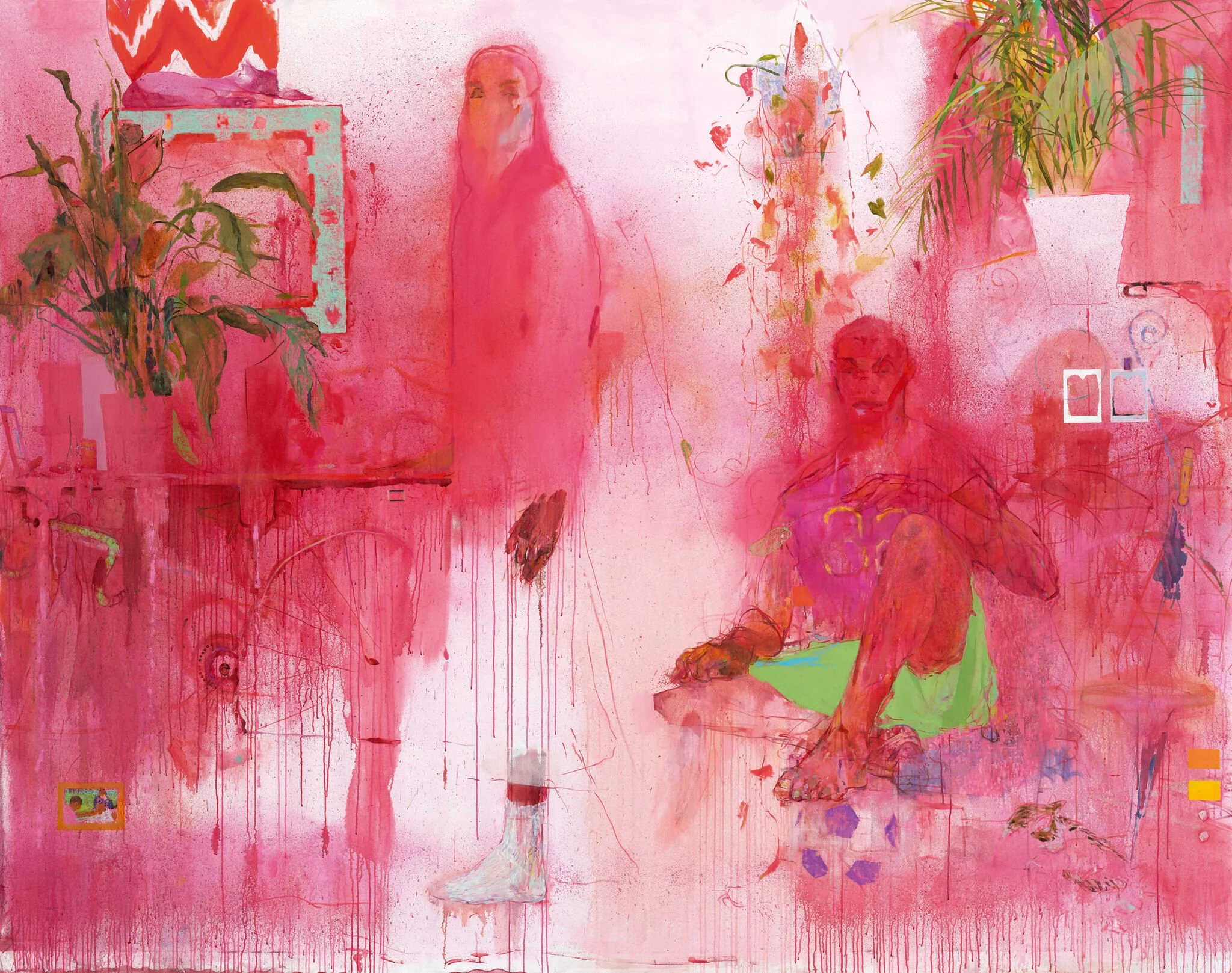
Jennifer Packer, A Lesson in Longing, 2019. Oil on canvas, 108 1/2 × 137 in. (275.6 × 348 cm). Whitney Museum of American Art, New York; promised gift of Dawn and David Lenhardt. © Jennifer Packer. Photograph by Ron Amstutz. Image courtesy Sikkema Jenkins & Co., New York, and Corvi-Mora, London
Take, for instance, A Lesson in Longing (2019). It engages Packer’s tendency towards monochrome in order to really explore a color, preferencing a largely magenta palette with some variations of green – one that was inspired by Jean-Michel Basquiat’s 1982 painting, Moses and the Egyptians (another Biblical reference)-- to depict two people in what appears to be a home-like environment with a cat, a soccer ball, and multiple plants. The oil is applied to the massive canvas in a manner that evokes watercolor or spray paint, unlike the classical use of oil paints. Washes of the vibrant red-pink are layered, dripping down the canvas to create an ethereal aura. Though the subjects are based on actual people Packer knows, the color choice and treatment of the paint conjure a surreality of sorts, bringing the viewer into what is more a reverie than a fever dream. These techniques allow Packer to limit access to the subjects, allowing some aspects of not only their image but their personal lives to remain private. This is a powerful statement considering that Western culture does not generally allow Black individuals – such as the ones commonly depicted in Packer’s portraits – that level of agency.
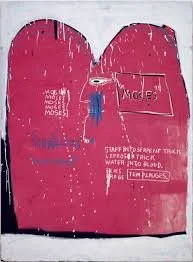
Jean-Michel Basquiat’s 1982 painting, Moses and the Egyptians
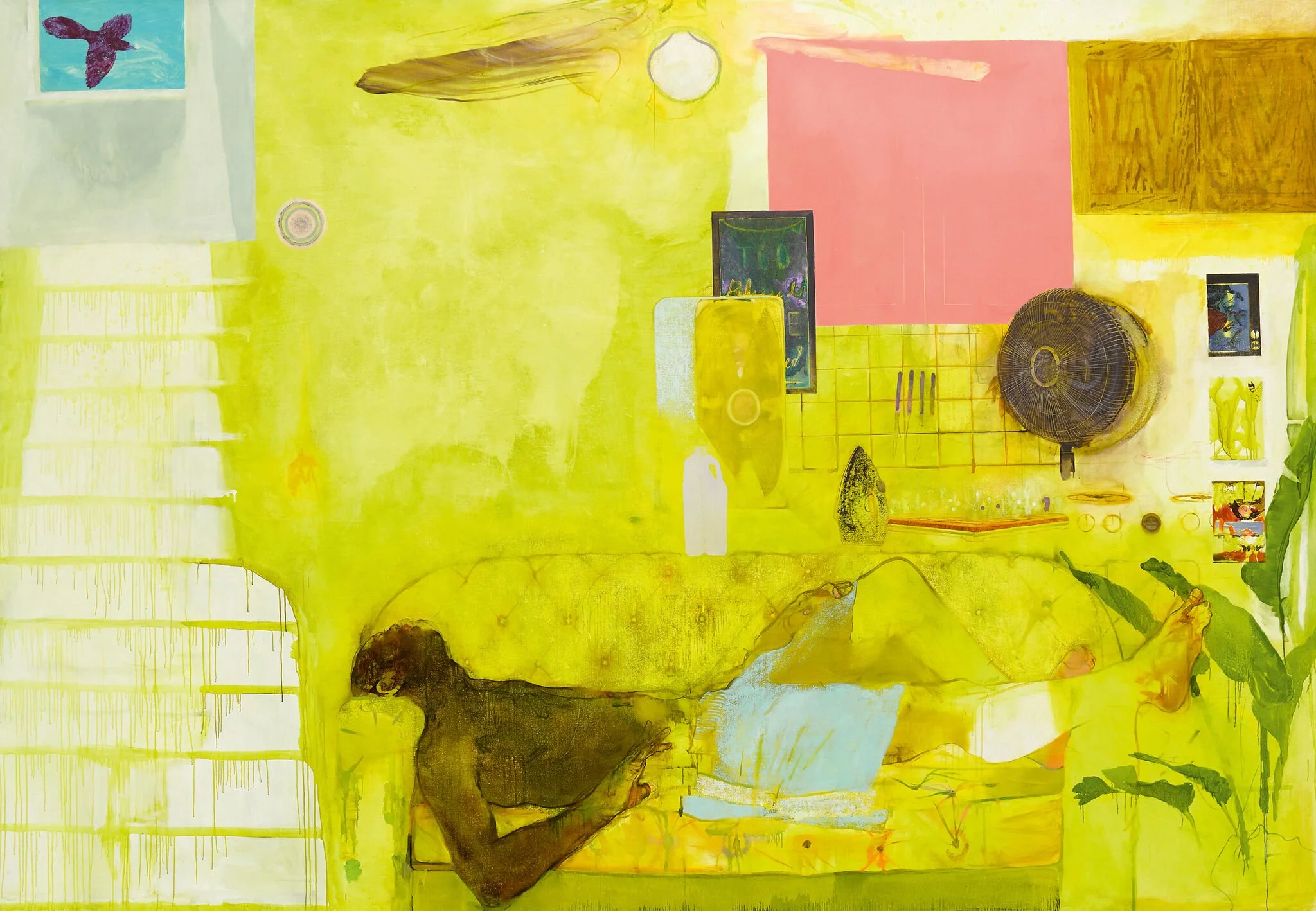
Jennifer Packer, Blessed Are Those Who Mourn (Breonna! Breonna!), 2020. Oil on canvas, 118 × 172 1/2 in. (300 × 438 cm). Private collection. © Jennifer Packer. Photograph by George Darrel. Image courtesy Sikkema Jenkins & Co., New York, and Corvi-Mora, London
Another Biblical reference is in the title of another fairly large painting, Blessed Are Those Who Mourn (Breonna! Breonna!) (2020). The title is taken from the Beatitudes and is followed by a perhaps more well-known verse, “Blessed are the meek, for they shall inherit the Earth.” A brown body is depicted reclined on a sofa. There appears to be a kitchen in the background, rendered sparingly so as to not give too much away. Flanking the lower level, Packer uses negative space to create the impression of a staircase leading to a window out of which a blue sky and a black bird flying free can be seen. Once again, a single color dominates the palette– in this case, it is shades of yellow. Most of the painting is a neon yellow that seems to create a sickly sort of dream state. Despite the presence of three different fans, the figure on the sofa wears only powder blue shorts and their body seems to be contorted in discomfort. The shape of it could reflect repose just as yellow could represent happiness – but here, neither does what it is expected to do. The head of the figure is tilted up in such a way that one might expect a guttural wail of utter exhaustion might soon fill the room. The viscerally textured fan and tell-tale drips coming from the plants, the couch, and the negative space of the stairs create the sense that this may be the hottest, relentlessly vivid, most deeply felt summer in ages. The house itself references images Packer had seen of Breonna Taylor’s home. Taylor– who the painting is named for and serves as a memorial of– was a 26-year-old Black woman who was murdered in cold blood in her bed by the Louisville police. Taylor’s killers were acquitted by a grand jury– an outrage that, coupled with the slaying of George Floyd, sparked a wave of civil dissent across not only the United States but the globe during the summer of 2020.
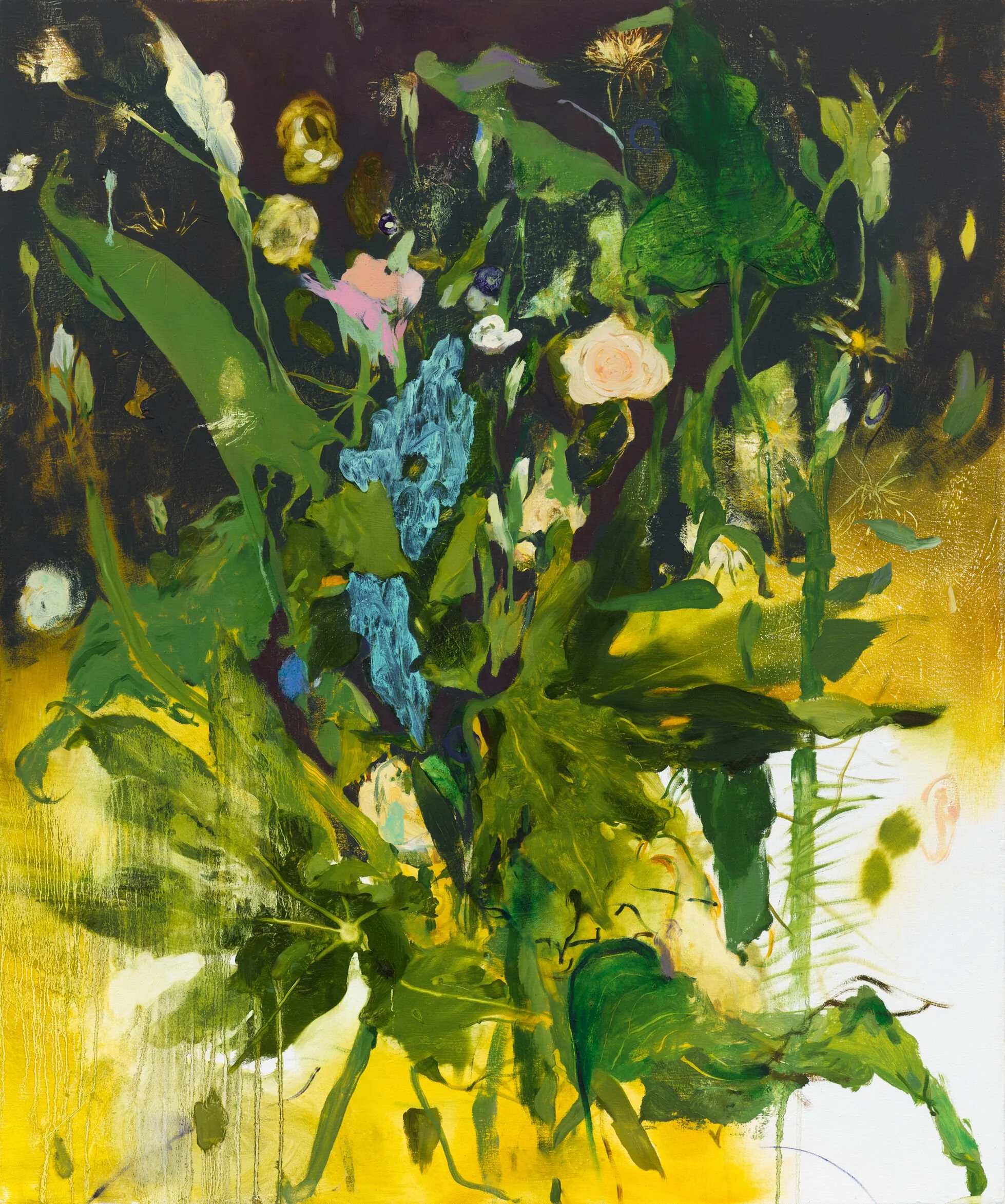
Jennifer Packer, Say Her Name, 2017. Oil on canvas, 48 × 40 in. (121.9 × 101.6 cm). Private collection. © Jennifer Packer. Photograph by Matt Grubb. Image courtesy Sikkema Jenkins & Co., New York, and Corvi-Mora, London
Blackness and the sacredness of Black lives – not Black exceptionalism– sits centerstage in Packer’s work. This is true even in her portraits of flowers. In Packer’s world, a painting bouquet of flowers is not a still life of flowers but a memorial of 28-year-old Sandra Bland who died in police custody after she was arrested three days prior for a minor traffic violation. Say Her Name (2017) holds the same enigmatic eeriness of a Francis Bacon painting, the same raw emotion of a Goya, and none of the distance from the subject that we see from the old Masters depictions of their sitters. The painting is especially bereft of the overexposure of brutalized Black bodies, Black death, and Black trauma that is much too common in mainstream media. In this way Packer’s desire to play with transparency and opacity through her primary medium of choice– oil on canvas– truly parallels her desire to control the level of intimacy the viewer is allowed to have with the subject.
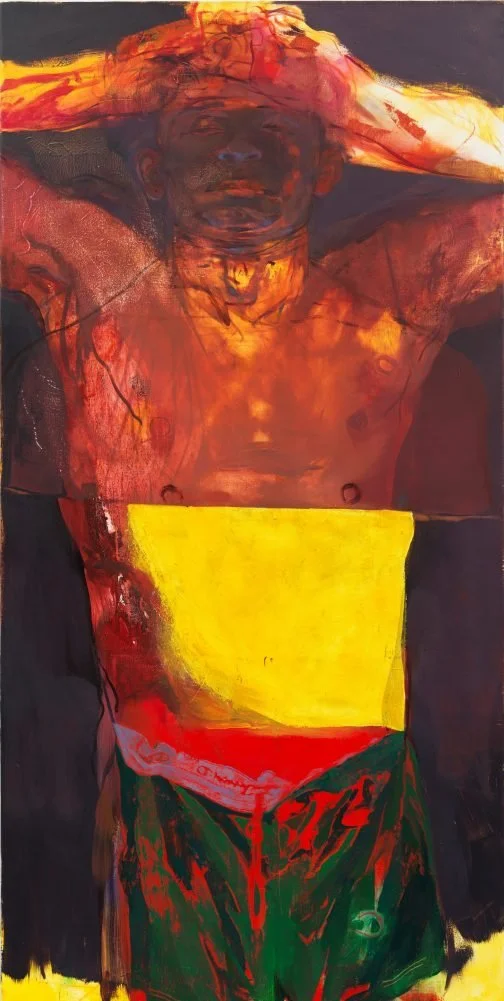
Transfiguration (He’s No Saint) (2017) courtesy of Jason Wyche
Transfiguration (He’s No Saint) (2017) invokes the spirit of Emmett Till, a 14-year-old boy whose mother chose to have an open casket funeral service for him after he was lynched on a trip to Mississippi in 1955. Till had been accused of flirting with, whistling at, or inappropriately touching a young white woman. His murder and the subsequent images from the funeral were hugely important to the civil rights movement, serving as proof positive of the abhorrence of lynching and the racism rampant not only in the South but the entire country. Perhaps it is the way the upper body was rendered fairly realistically with brown skin versus the lower body shown with gaunt yellow skin that almost makes the body seem bloated. The lower body in fact seems to drip vibrant red like blood spilling over navy blue bottoms from what looks like a stab wound in the side. The garish colors come together to echo the slain Christ figure who was stabbed in the side during his crucifixion. It is as graphic as the clash between the primary colors present. The decision to render the body as two separate parts of a whole evokes the imagery of a body in an open coffin – much like Emmet Till. Once again, the visual and literal language of the sacred is used to speak to the sanctity that is robbed of Black bodies in this political paradigm. It is worth noting that the year the painting was made was the year that Emmett Till’s accuser, Carolyn Bryant divulged that the incendiary claims that he had sexually harassed her in any way had been complete fabrications – she had lied, martyrizing him for decades to come.
Carolina (2011) depicts a Black body with breasts represented top nude – the figure wears dark wash pants and sits in a room that seems to converge in a bizarre manner, a door sliding into what looks like a toilet, all sliding out of frame. Another Black figure is represented reclining behind the subject foregrounded who is facing the viewer, but whose eyes are obscured by a blue baseball cap. There is nothing sexual about the foregrounded subject, which problematizes the representation of the female body in Western art, primarily painting. Packer has said that she would never depict a Black woman reclining in a manner that is reflective of her desire as a queer woman as that stance would belie her politics, and the air of this body is holistically non-sexual. Any interpretation of sex would be a projection of the viewer.
Without holding viewers hands and without being too (though I wouldn’t say at all) didactic, Packer is able to powerfully communicate her internal landscape– be it emotional or philosophical– on the canvas. Her explorations of color allow viewers to spend more time making sense of what is and is not present in the frame. The masterful balance between what can and cannot be seen, what is and is not depicted speaks to the intimacy of knowing and not knowing. There is a vulnerability to all of Packer’s subjects – both depicted and ideological– that is protected by her choice to only uncover what needs to be uncovered. Personally, I don’t need to know more than what Packer has shown us. However, my eye is unsatisfied with what we have seen and certainly I would like to see more.
West Coast Displacement at Hauser and Wirth
I walked about ten blocks from the L train at 8th Ave to Hauser and Wirth to see Jenny Holzer’s new show, Demented Words. I had not looked at my transit app, assuming that I knew the quickest, easiest way to get there – I did not. This hubris cost me as my excitement at the prospect of seeing Holzer’s work had waned by the time I arrived at the world-renowned, blue chip art gallery.
I have seen sculptures and installations by Holzer at the Tate Modern prior to learning anything about her in Contemporary Art History, and as a fellow sucker for words, I very much liked her style. I knew that I’d have to take out special time to see her and Barbara Kruger’s New York shows this fall. This show, however, was extremely topical and the topic is one that I do not think is particularly interesting. I appreciate the simplicity of Holzer’s work as it is very easy to understand despite brilliant attention to medium and site specificity, but it becomes less powerful when the idea being communicated is equally as simplistic and lacking in depth or nuance. Espousing “liberal” or leftist ideologies is no longer a part of the counterculture nor is it provocative; it shows a failure to transcend the trap of binary opposition or provide a productive solution to the issue. The fact that a fine artist is making a scathing critique of former US President Donald Trump feels like preaching to the choir -– certainly not the statement that I think she thought it ought to be. Despite the visual splendor and thoughtful use of materials, it was hardly intellectually stimulating.
Disappointed, I decided to head upstairs. I had never been to this Hauser and Wirth location– only the 69th St location to see Hilma af Klint’s work– so I decided to see what else they had to offer. I was not captivated by the second floor installation of black and white photos regardless of their beautiful composition and more nuanced topicality. Despite my certainty that I would find more of the same on the top floor, and against my impulse, I decided to go ahead and check the show, In 24 Days tha Sun’ll Set at 7pm out.
I’m glad I did. As soon as the elevator doors pulled apart, I was shocked to see the vibrant washes of acrylic paint on raw canvas contrasting dark Earth tones such as navy, gray, and brown on a large, 86’ x 130’ canvas ahead of me. I was intrigued.
Walking past the gallery attendant sitting at the desk which had a copy of the artist, Christina Quarles’s book from a previous exhibition, I looked around the large white room with its concrete floor. If I’m very honest, I was too captivated by the paintings to pay much attention to the wall text, which I believe was positioned behind the attendant desk before the entrance to the gallery. This is a smart placement because it doesn’t serve to distract viewers from having an unobstructed view of the exhibit. With the painting inventory in hand, I entered the space.
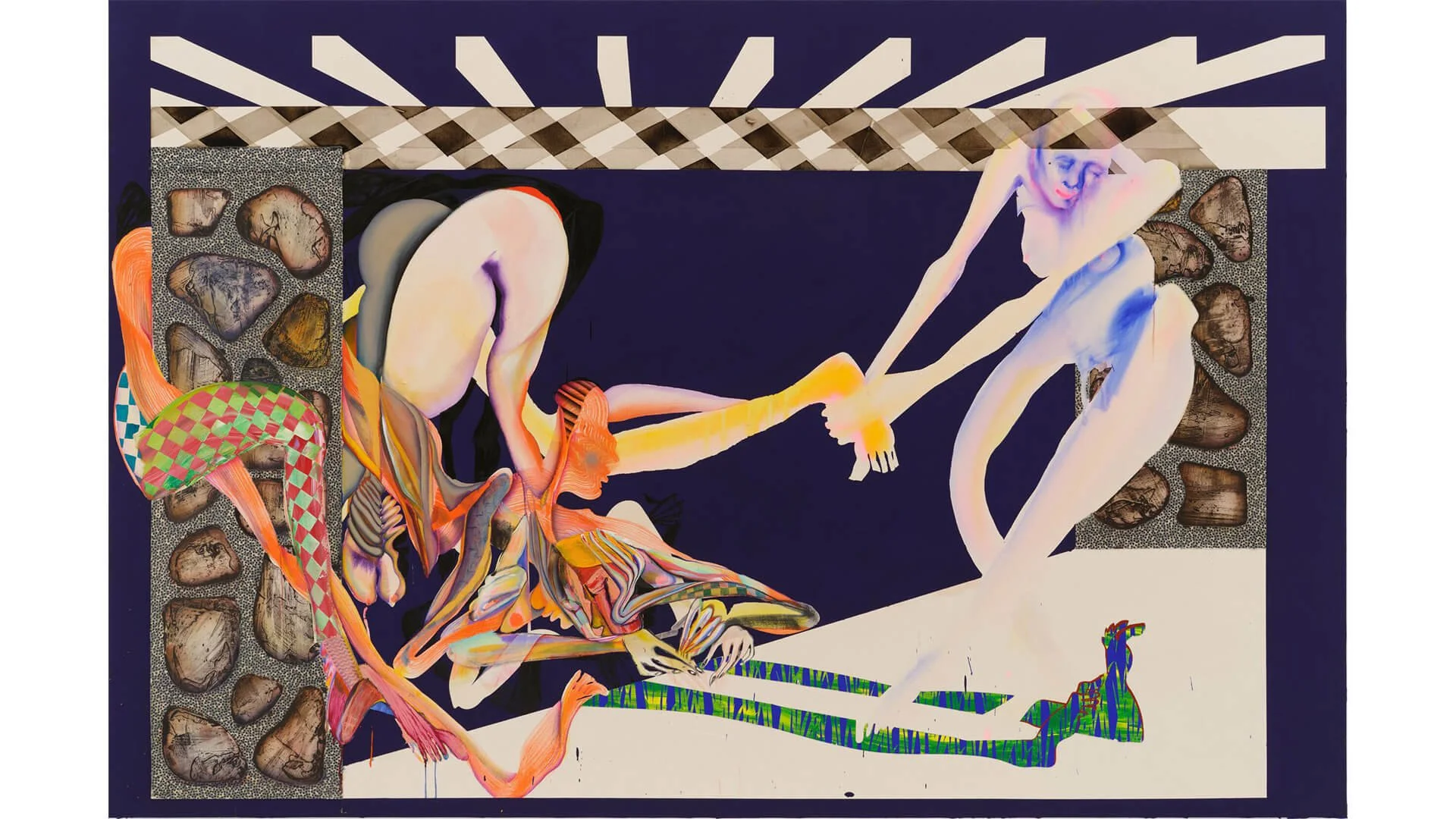
Kicking n’ Screaming (2022, acrylic on canvas, 86” x 130”)
I had never heard of Quarles but much like the artist Jennifer Packer, she is a relatively young Black female artist receiving critical acclaim in the past few years. Packer– whose work is quite similar in technique and subject matter– recently had a solo exhibition on the top floor of New York’s Whitney Museum. It’s safe to say that Hauser and Wirth’s institutional power rivals that of the Whitney – at least when it comes to reputation. This show follows a run at the 2022 Venice Biennale and precedes her showing work at the 16th Biennale de Lyon this fall.
“My project is informed by my daily experience with ambiguity and seeks to dismantle assumptions of our fixed subjectivity through images that challenge the viewer to contend with the disorganized body in a state of excess,” Quarles writes on her website. Being a queer-identifying, cis woman born to a Black father and white mother, Quarles’ grappling with identity and the different ways her presentation and positionality within the social world effect her place in it is put directly onto the canvas where the worlds she creates appear to fall apart to fall together.
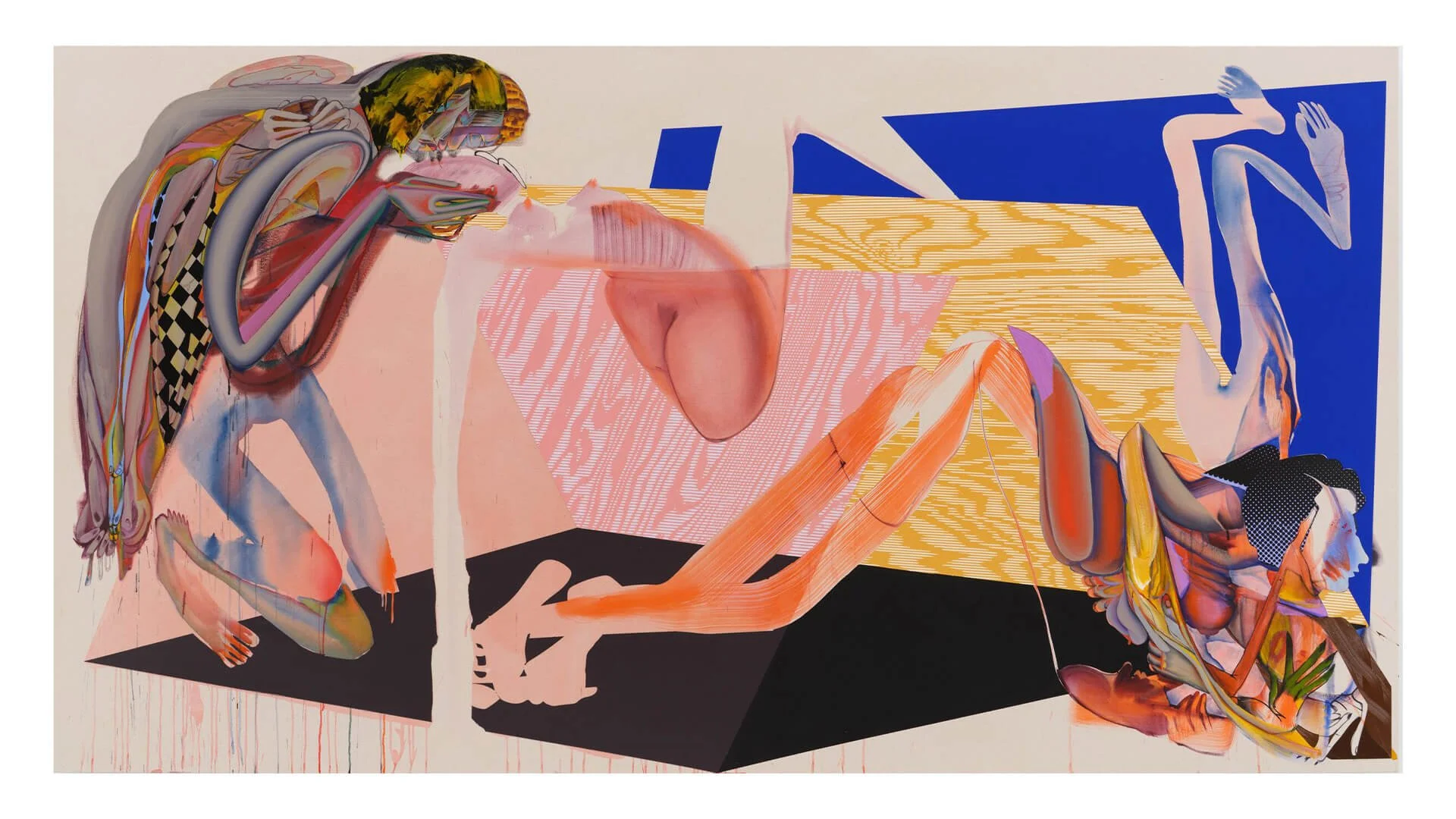
Same Shit, Diff’rent Day (2022, acrylic on canvas, 70” x 130”)
Quarles is a Los Angeles-based artist (though originally born in Chicago) which is evident from the bright colors, translucent washes, and psychedelic icons she utilizes. Despite the fact that the eight paintings showcased in her first major solo exhibition in New York were painted in Somerset, England, they have a distinctly West Coast tone to them. The colors are vibrant like those used by artists like John McCracken and the varying layers of opacity created using acrylic paint evokes other West Coast Minimalists such as Larry Bell. Unbelievable textures are created by Quarles, who is able to create what looks like stencils or pieces of fabricated plastic cut-outs out of just acrylic paint. This, too, references West Coast Minimalist practices.
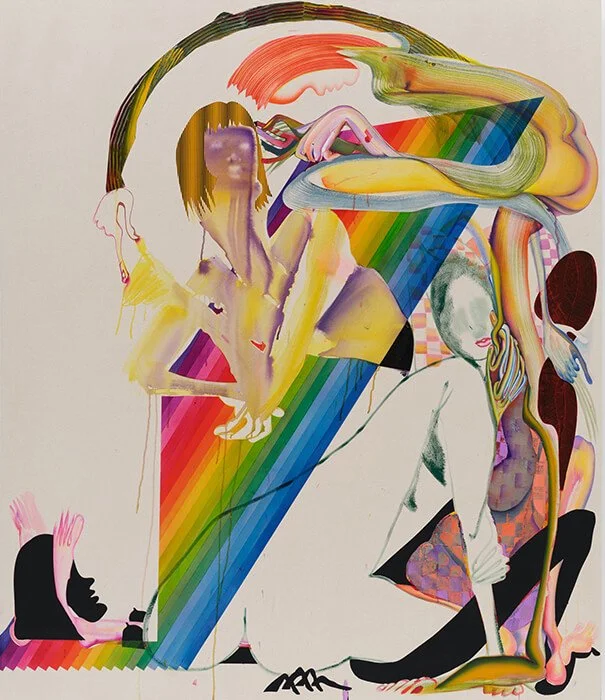
Try n’ Pull tha Rains in on Me (2022, acrylic on canvas, 72” x 84”)
Through practical application Quarles also manages to create outstanding textural icons signifying things from water to wood to hair. Bodies figure largely into the work – no pun intended. These bodies seem to spill across the canvas – like the one seemingly falling out of a martini glass in Same Shit, Diff’rent Day (2022). Soft application of diaphanous hues of purples, pinks, and oranges that inspire sunset references create a suppleness to the symphony of limbs just as much as the lack of paint that creates contours from fragmentation and negative space.
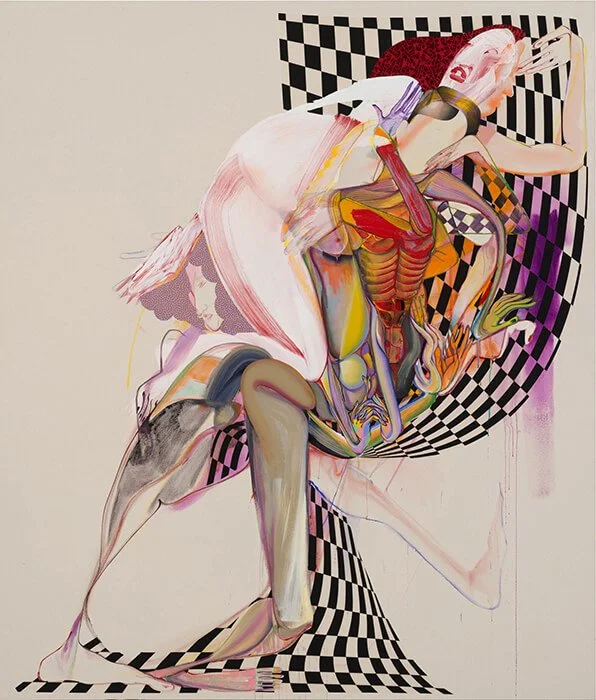
Caught Up (2022, acrylic on canvas, 84” x 72”)
By painting forms directly onto canvas without creating a background like in Try n’ Pull tha Rains in on Me (2022) or by creating matrices with the illusion of being three-dimensional floating in the void of the un-gessoed canvas like in A Song For You (2022), Quarles alludes to the relationship between the human body and the experience of space and time. This allusion is made again with the warping black-and-white checker pattern in Caught Up (2021) which both references Bauhaus as well as 1960s mod style. This time jump – which is still relevant and is coming back into style in this contemporary moment– brings us back to that reference of the corporeal experience of temporality. By creating ungrounded spaces that both collapse in on themselves and hold up languid and almost unintelligible bodies, there is a sense that these structures are created and enforced by the human mind as it processes through the nervous system. Dislocation edges close to being the subject of the paintings.
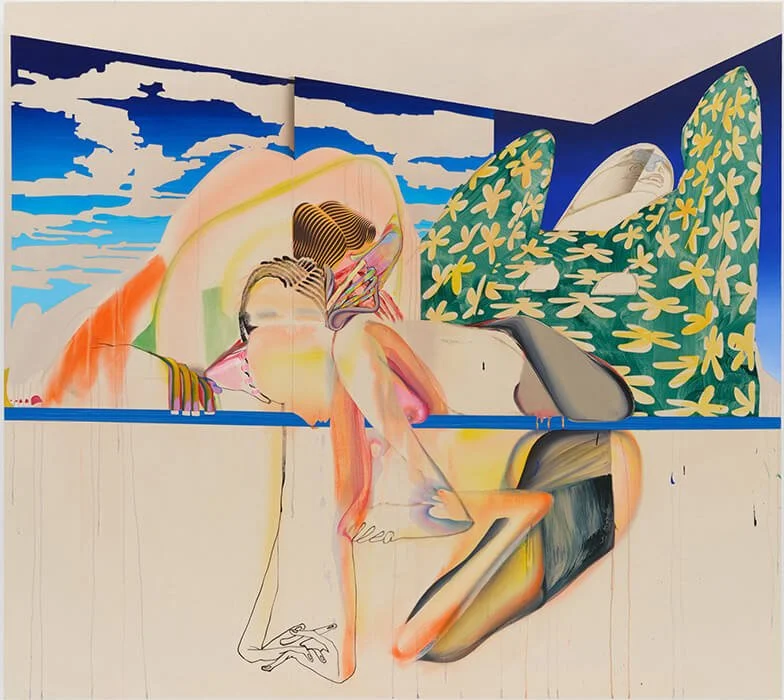
A Song for You (2022, acrylic on canvas, 77” x 86”)
This ephemerality is referenced by the gossamer density of technicolor feet in the painting the show is named for, In 24 Days Tha Sun’ll Set at 7pm (2022). Sometimes tendons are signified through denser application of paint that looks more like acrylic paint than the watercolor-like swatches of flesh swimming through the paintings. The experience is sensual and ethereal; equal parts powerful and intense, supple and delicate. From left-to-right, viewers are transported through Quarles' sojourn to Somerset on a zephyr of psychedelic perception evinced by brilliant rainbows, ombre skies falling apart, and harmoniously resonant orbs that appear luminously as if from some alien sky.
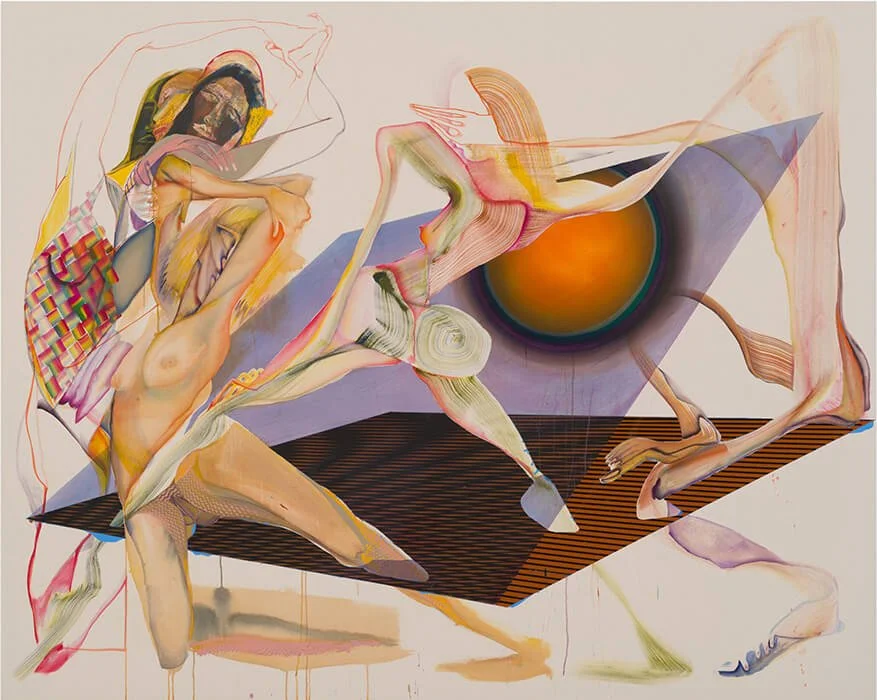
In 24 Days Tha Sun’ll Set at 7pm (2022, acrylic on canvas, 77” x 96”)
Somatics are much more powerful than they are given credit for. They presuppose and predicate any and all ideological structures we as humans may create. The subtle viscerality of Quarles’ work is a powerful reminder and ode to that – there is so much more to our experience than meets the eye.
Photos courtesy of Hauser & Wirth
Mini Essays
Essay 1
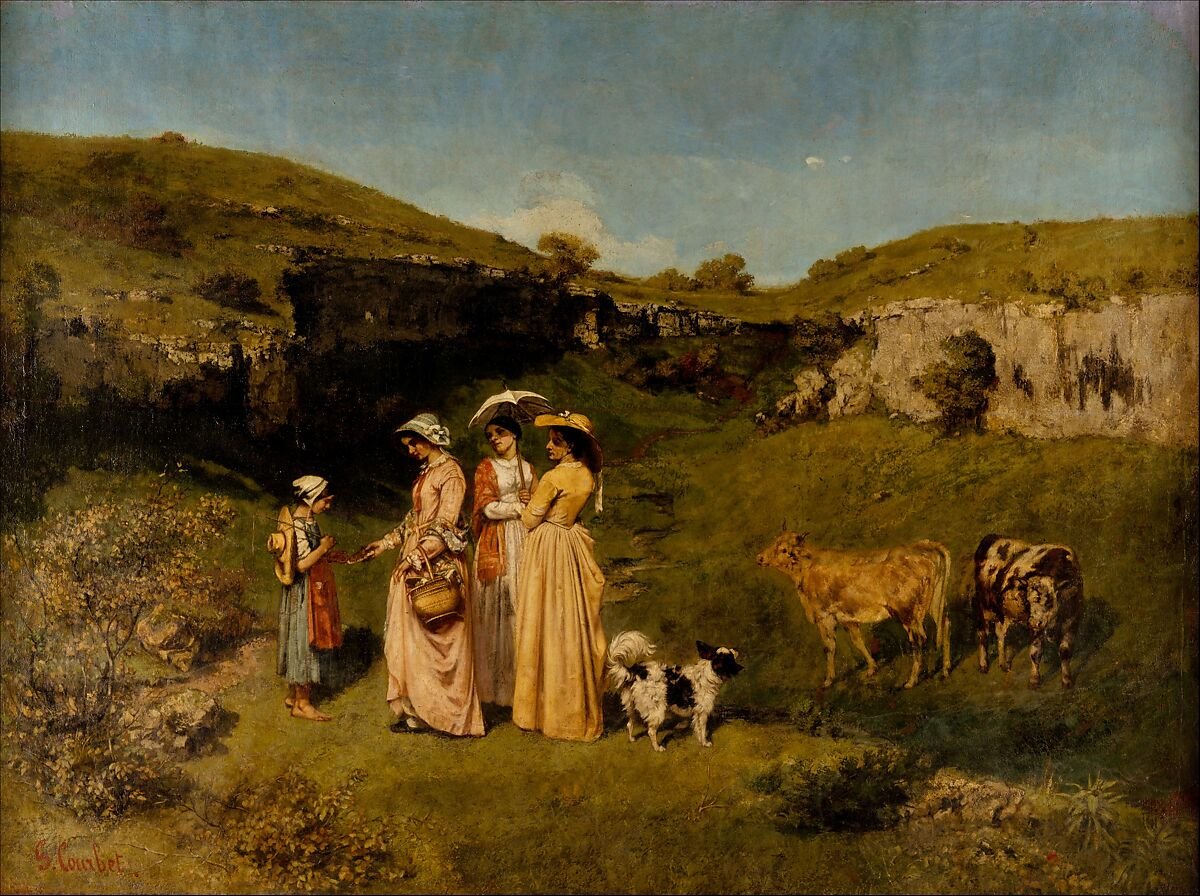
Les Demoiselles de village (1852) by Gustave Courbet courtesy of the Metropolitan Museum of Art
Young Ladies of the Village or Les Demoiselles de village (1852) by Gustave Courbet is an oil on canvas painting showing three young ladies offering a younger cowherd alms. Standing in a verdant valley, the girls are in the Ornans countryside, a common setting for Courbet paintings. The older girls wear simple, pastel dresses of pink, yellow and white which shows their (probably only slightly) higher class standing than the shoeless girl in her tattered blue dress and straw hat hanging behind her. The scene is quintessentially provincial, which did not please the elitist sophisticates of the Salon, who decried the use of the characterization of the girls as “ladies” at all. It was ripped apart as having been lacking taste and skill. Courbet was so affronted by such accusations that he remade the painting in a manner that conveyed his technical prowess much more than the original. Courbet’s lack of detail and perspective in his paintings was a choice that really lays the groundwork for Impressionism.
Perhaps this desire to be well-received (which Courbet struggled with throughout the entirety of his career) is what encouraged him to paint Young Ladies on the Bank of the Seine or Les Demoiselles des bords de la Seine (1857). This painting is more modern as it is set in Paris, so though it is outdoors in a seemingly pastoral setting, it is still in the city. The subject matter is seemingly innocent upon first glance but it’s as shocking a theme as Demoiselles de Village, if not more so. The painting displays a set of young women lounging upon the banks of the Seine in delicate, ornate clothing. The girl in the foreground is dressed in white but clearly in her underclothes, her sensual gaze one of someone in a subdued haze. Her body is so limp she appears to be completely spent. Perhaps her dress serves as her pillow and her shawl, her blanket. A bouquet of flowers rests behind her head. The girl beside her gazes off into the distance, quite detached, gently grasping her own bouquet of flowers. In the boat behind them, there is a man’s hat.
Courbet -- infamously never one to shy from notoriety or controversy-- took upon himself the task of portraying the working class (which he was not a part of). This fascination with real life people becomes a big part of modern painting. In this painting, instead of three girls (his sisters) from a rural town being characterized as ladies, he portrays two prostitutes. The Salon hated this, but Courbet is combatting the rigid classism of the art elite that ruled the institution. Why are these women less worthy of being the subjects of paintings than ancient damsels, aristocratic wives, and mythological goddess figures? Why couldn’t real women be portrayed in portraiture? Though I wouldn’t argue that Courbet was a feminist-- a provacteur certainly-- the subject matter does break down barriers around what kinds of women serve as subjects, creating a massive space for the brilliant Manet to repeatedly paint prostitutes to an almost obsessive degree. Both paintings serve as revolutionary moments in Courbet’s career that would solidify him as a heavy hitter in the battering against the bulwark that was the Salon’s snobbery.
WORD COUNT: 539
Essay 2
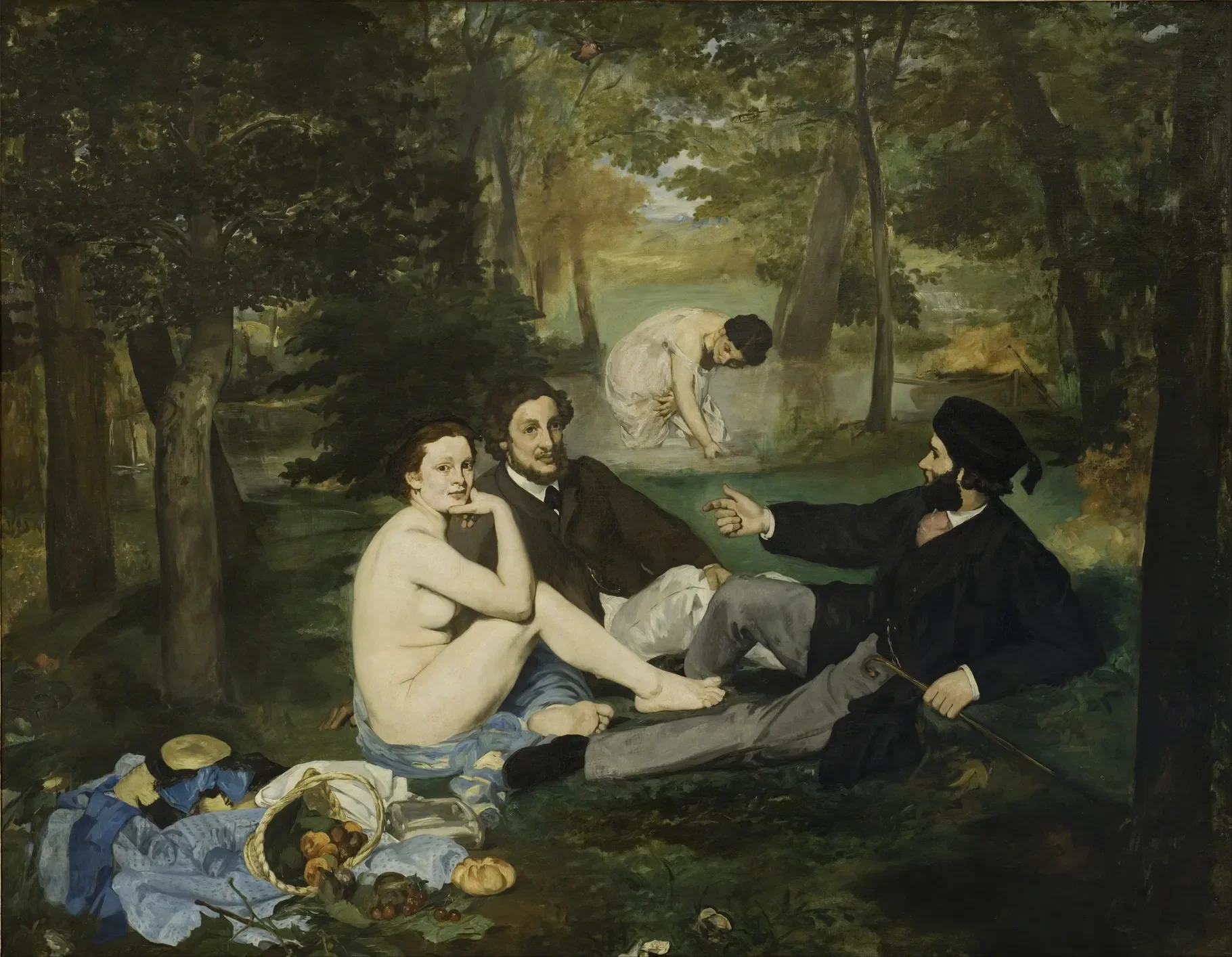
Luncheon on the Grass (Le Déjeuner sur l'herbe) (1863) by Édouard Manet courtesy of Artsy
As a segue from the portrayal of prostitutes inspired by Courbet-- to which much of modernism in art is owed--, we come to Manet’s Déjeuner sur L’Herbe (1863). The painting shows a young nude woman accompanied by two fully clothed men and another woman who occupies the background. The woman in the background seems to be washing something in a small river looping behind the trio of figures and like Courbet’s painting, they are in a public park in Paris. This fully nude woman-- Manet’s muse and model, Victorine-- stares directly at the viewer, her clothes positioned behind her, seeming to be slightly amused but not daunted by our intrusion as her companions carry on a conversation. They appear to me as students, perhaps waxing philosophical about some matter of intellectualism or another. This painting harkens to the work of Titian, inspired by his Concerting in the Open Air (1510-1511). This painting shows a real woman-- a working woman participating in an unfortunately popular career for the lower classes at the time-- which did not fit into the social mores of painting in 1860s France. At this time, the Salon de Venus was taking place and we can rest assured that Manet’s painting was not showing a Venus whatsoever, and so this painting was rejected by the salon. It did however get shown at the Salon de Refuses that was ordered by Napoleon III.
We can compare the subject matter to Monet’s Femmes au Jardin (1866). This plein air painting shows four women dressed in peak fashions of the time enjoying the garden of his suburban home. The attention to detail in the dresses the women wear is extravagant and characterizes the painting in the modern period, similarly to how the flaneur suits of the gentlemen in Manet’s painting and the discarded blue and white clothing of Victorine show that the paintings are contemporaries. Sun filters in through the leaves and the dappling of the shadows reflects the impression aspect of Impressionism. A girl sits beneath a tree, shielding herself with a parasol as she contemplatively fingers a bouquet in her lap -- perhaps she is reminiscing about a lover. Another completely shields her face but looks out at the viewer. She stands next to another underneath the tree as the fourth young woman darts behind the tree, her white dress covered in black polka dots streams behind her. Is her fleeing playful? The other women do not seem to be embroiled in play.
Unlike Déjeuner sur L’Herbe, there is no real context or story in Femmes au Jardin, and the Salon did not receive this painting well at all. Femmes au Jardin is, however, extremely successful in rising to the challenges of the interplay of light and shadow that so fascinated Impressionist painters. Monet brings that tradition to a painting that is not solely landscape, effectively reflecting motion and tactfully expressing silhouette using not only contemporary clothing of the time but the landscape he and the other Impressionists so loved to portray.
WORD COUNT: 501
Essay 3
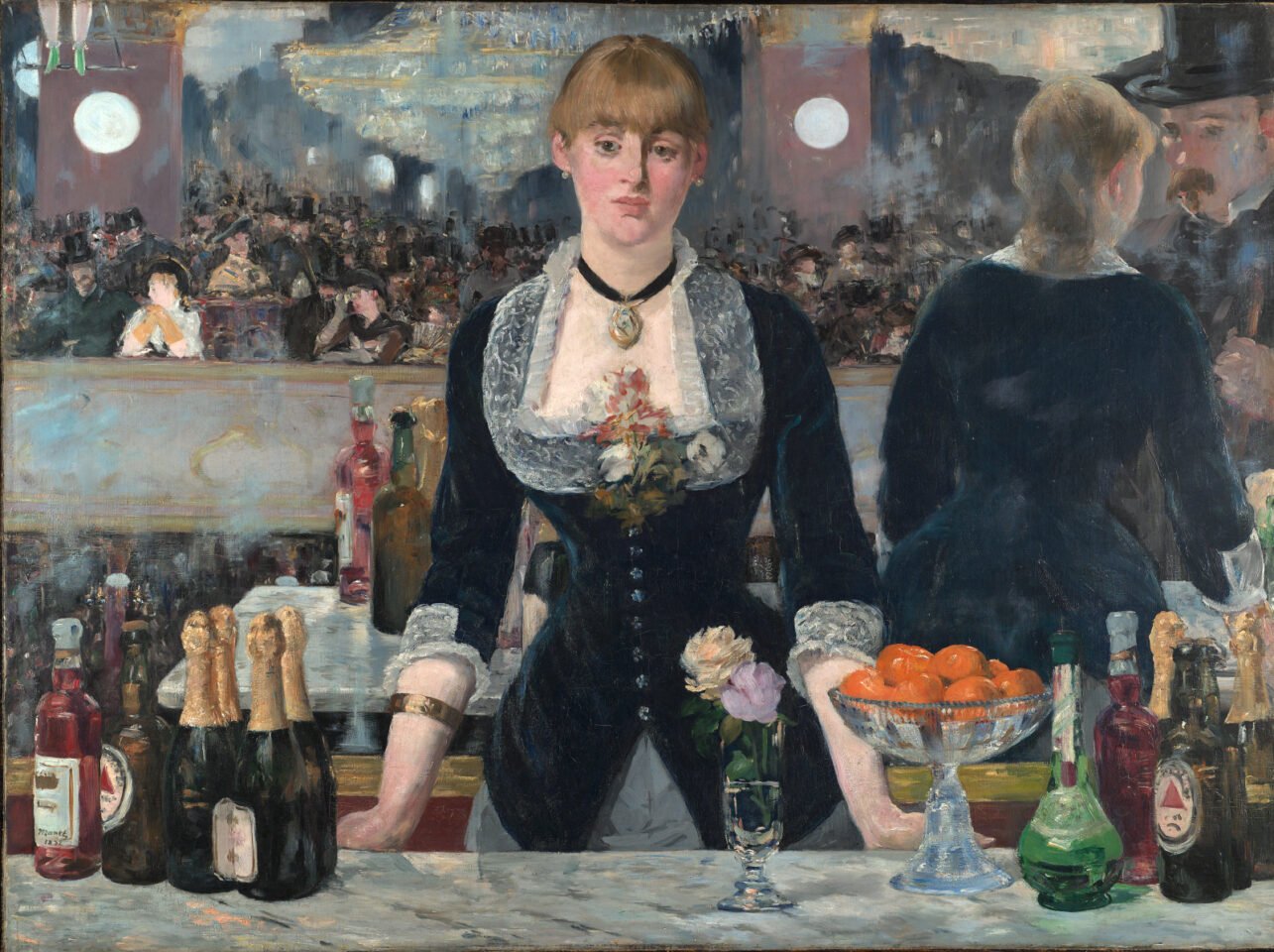
A Bar at the Folies-Bergère (1882) by Édouard Manet courtesy of The Courtauld, London
Seeing and being seen was an important part of Parisian culture in the mid to late 19th century. Leisure was being introduced to society and as modernity swept the town, it brought along with it more people from the country looking for work, more women looking for work, and more of a public life that involved socializing in public spaces. All of these themes are interwoven into the brushstrokes of Auguste Renoir’s Dance at the Moulin de la Galette (1876) and Edouard Manet’s A Bar at the Folies-Bergère (1881-82).
Both paintings are situated in public spaces that may have served as a sort of scene for (particularly) the bourgeoisie. Renoir’s painting plays with dappled light and shadow, employing seemingly broken brushstrokes to convey an afternoon scene in a busy area of Montmartre. The area became something of a cultural center and the painting evokes Manet’s Music at the Tuileries (1862) as we seem to enter into a cadre of revelers enjoying music amongst the trees. Some are seated, enjoying a drink. Perhaps these young men are talking to their waitress or perhaps a prostitute-- in this time, it could always be a prostitute. Men and women embrace one another to dance and children are present, lessening the possible underbelly aspect that becomes a strong Impressionist theme.
More akin to Manet’s A Bar at the Folies-Bergère, we see the presence of newer inventions such as lamps. A Bar at the Folies-Bergère not only engages these new luminaries but challenges perspective by placing the subject in front of a mirror, so we see that she is looking rather deflated as she speaks to a customer at the bar of a very well known event space. The mirrors double everything but they may even make an infinite loop by facing one another. While Renoir’s painting exhibits a certain gaiety, there is a level of despair in Manet’s that comes from being a working woman in this brightly lit scene. The white orbs displayed in the mirror behind the young lady with flowers tucked into her bosom are slightly blinding and the painting feels less like a reverie and more like a fever dream of fear and loathing, a certain distortion of reality that that mirror-to-mirror effect over her left shoulder may convey.
We see a performer’s feet in the top left corner of A Bar at the Folies-Bergère, signaling a great attention to detail despite the obvious brushstrokes characterizing some of the painting. It becomes very fantastic but not in as glamorous a way as we may perceive of it, it being set in a famous music hall. The young lady’s blank expression expresses a vacancy that implies she is no longer present in reality -- perhaps she is on autopilot-- thus adding another layer of disengagement from reality while employing Realism. Manet’s painting was accepted by the salon, which is surprising considering that the Salon were not huge fans of his.
WORD COUNT: 484
Essay 4
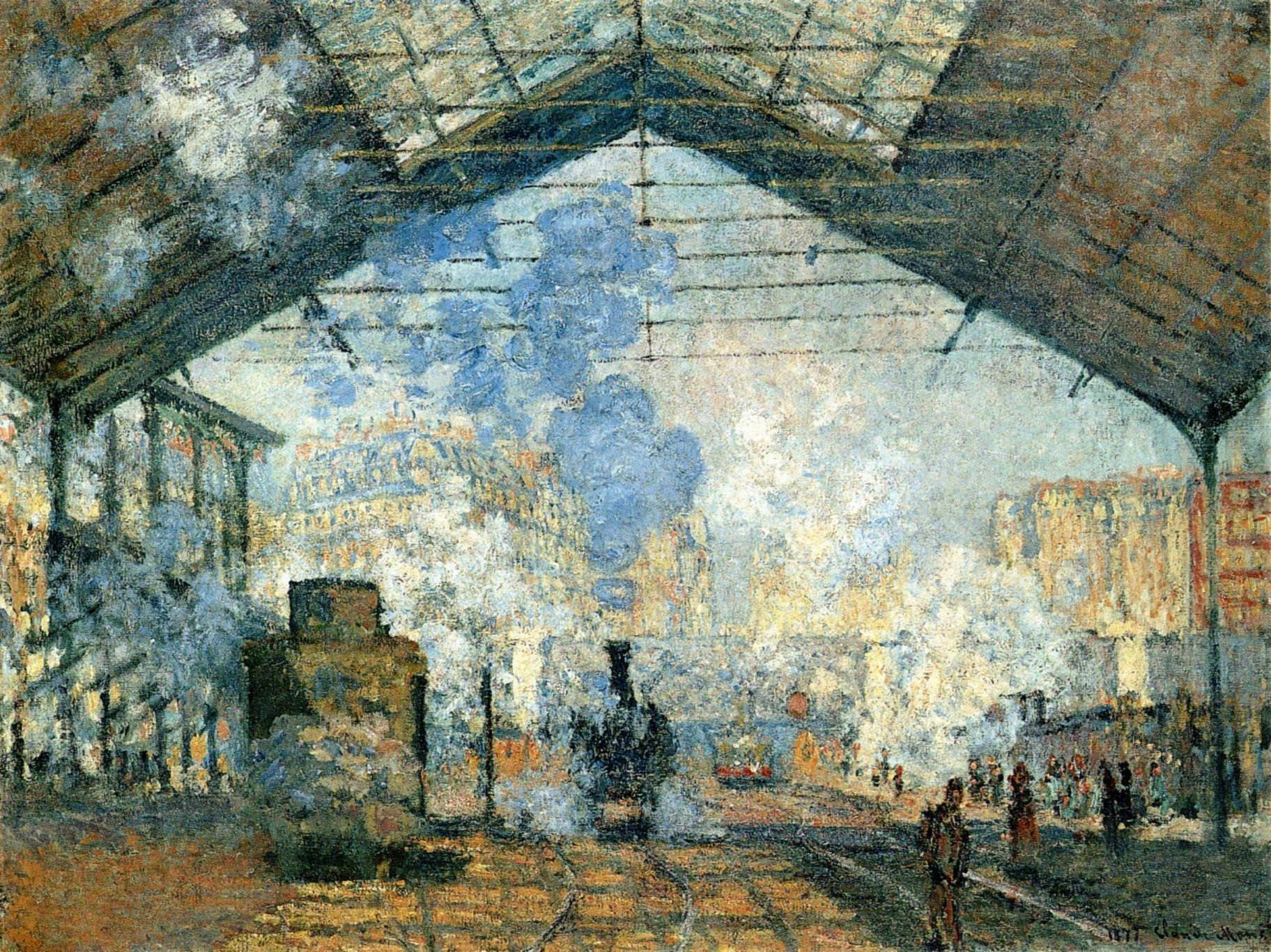
Gare St Lazare (1872-73) by Claude Monet courtesy of Impressionists.org
Another important hallmark of Impressionist painting was the train station. Painters of the time were oft fascinated by the industrial trappings and mechanisms that came with modernity as signs of human advancement and innovation. What better place to survey this than the train station? Many artists set up their canvas at the new train station that would shuttle folks to the suburbs and back called Gare St Lazare on the edge of Paris. Manet even had a studio by the station, which he painted into his Gare St Lazare (1872-73). Five years later, the Impressionist painter Monet would create a famous painting of the same subject matter but that is distinctly different.
The train station in Manet’s painting is more implied than it is present. The real subject of the painting is the woman and little girl outside the station fence. We know that they are outside because we see a plume of smoke on the other side, which the young girl is facing, giving us a great view of her calf-length white dress and it’s giant blue bow. Beside her sits a young woman who may be her nanny. The woman’s hat doesn’t match her dress, implying that she is not of a very sophisticated class. She is not likely the girl’s mother or sister as their dresses do not match. She holds a book and a sleeping dog. This may not be a prostitute, but she is still a working woman, a subject much beloved by Manet. This painting reads more as a portrait which perhaps accounts for why it was accepted at the Salon.
The brilliant white of Manet’s Gare St Lazare is a bit of a departure from his usual palette and is owed to the Impressionists who enjoyed working with light and shadow in their paintings, not as the old masters did but in new and adventurous ways that did not win much favor at the salon. Where we are also used to seeing his paintings set in pastoral settings, this is not the case here. This change of scenery reflects the passage of time and speaks to the impact on modern Paris made by Baron Georges-Eugene Haussmann.
Monet’s Gare St Lazare (1877) is inarguably more centered on the train station itself. It appears that the viewer stands on a platform between the tracks, so that we see a train arriving and perhaps one departing. We are under the glass roof and have view of the elegant moulding that holds up the glass as well as the unlit lanterns. Steam obscures much of the sky as it pours from the chimneys of both the arriving and departing trains. We see a taste of Haussmanization in this painting depicted in the roof and facade of a far off building. Monet would paint this same painting over and over again, studying the differences in light and mood as it related to time-- and what better place to speak to the passage of time than a train station (other than perhaps a clock tower).
WORD COUNT: 506